Which payment providers work best with Shopware 6 in the EU/UK/US?
Our Take
For most Shopware 6 stores, Stripe is the safest default choice in both the EU and US because the plugin quality is solid, wallet support is excellent, and subscription or multi-market setups are easier to manage long term. But if you’re running a high-volume EU store with local payment methods as a priority, Mollie usually converts better at checkout and needs less custom work around SEPA, Klarna, iDEAL, and Bancontact.
Recommended
Stripe
- Best API ecosystem and developer tooling for Shopware customisation
- Excellent Apple Pay, Google Pay, Link, and subscription handling
- Works especially well for headless builds and multi-country setups
- Usually the easiest provider to scale internationally without changing stack later
Best if: You want one payment stack across EU, UK, and US stores with minimal operational complexity.
Mollie
- Excellent support for local EU payment methods out of the box
- Usually faster to configure for VAT-heavy European stores
- Klarna, SEPA, SOFORT, iDEAL, and Bancontact support is cleaner than most alternatives
- Merchant onboarding is often simpler for mid-sized EU retailers
Best if: Most of your revenue comes from mainland Europe and local payment adoption matters more than global expansion.
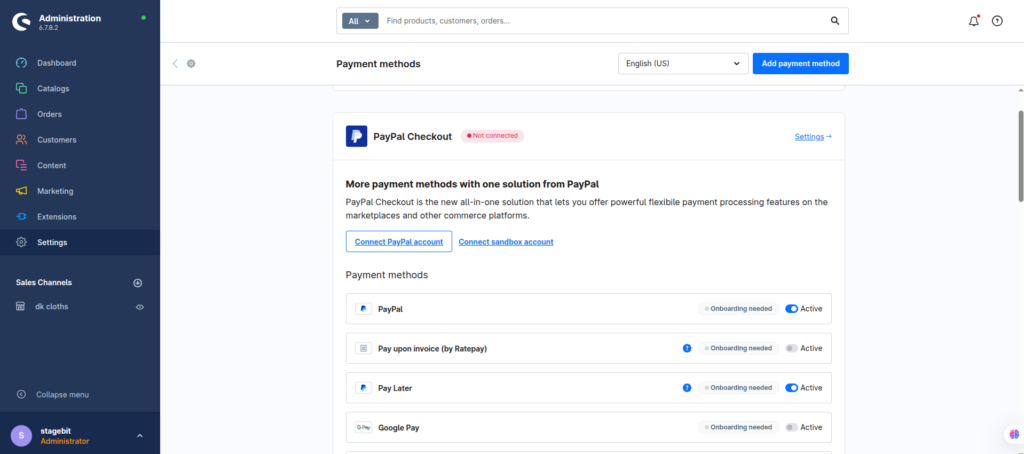
PayPal still matters more than most teams expect. Even stores with strong card conversion usually keep PayPal because returning buyers trust it and mobile checkout completion stays high. We rarely recommend using PayPal as your only provider though. The Shopware plugin works fine, but operationally it’s weaker for complex order flows, subscriptions, and ERP-heavy environments.
Adyen is the enterprise option. It shines when you have multiple legal entities, physical retail, unified commerce, or large international operations. But for most mid-market Shopware builds, Adyen adds more implementation overhead than the business actually needs. Unless your payment volume is already substantial, Stripe or Mollie will get you live faster with fewer moving parts.
For UK stores specifically, Stripe tends to win more often than Checkout.com or Opayo unless you’re negotiating custom enterprise rates. The Shopware ecosystem around Stripe is stronger, developer hiring is easier, and troubleshooting is faster because more agencies have worked with it repeatedly.
One thing developers regularly underestimate is plugin maintenance quality. The cheapest transaction fee is meaningless if payment state sync breaks during Shopware upgrades. We generally trust Stripe, Mollie, PayPal, and Adyen integrations more than smaller gateway plugins because release cadence and API documentation are consistently better.
Worth it if:
You sell across multiple countries, support digital wallets, or need subscriptions, instalments, and ERP-safe payment flows without custom middleware.
Skip it if:
You’re choosing providers purely on transaction fees while ignoring plugin support quality, payout handling, and operational stability after Shopware updates.
Who This Is For
EU stores needing strong local payment support like iDEAL, Klarna, SEPA, and Bancontact.
Shopware builds using subscriptions, headless frontends, mobile wallets, or multiple regional storefronts.
Technical managers who care more about stable operations than chasing the absolute lowest transaction rate.
Tiny single-country stores processing very low order volume. A simpler PayPal plus basic card setup may be enough initially.
Stores choosing enterprise gateways before validating checkout conversion or operational requirements.
Related Answers

Still need help?
Talk to our Shopware experts
We've handled GDPR/CCPA compliance for dozens of EU & US Shopware stores.